
I first came across Packer from his cover story “The Valley,”—the second-longest that The Atlantic published in the past 40 years, in which he provides a kaleidoscopic view of the precarious political and physical ecology of Phoenix regarding climate change, which meant a lot to me in the summer of 2024 as we were suffering record-breaking, triple-digit temperatures. I had no idea he was a Returned Peace Corps Volunteer until a fellow PCV (Peace Corps Volunteer) serving in Togo gave me a heads-up.
When I started reading his memoir, I realized it was ideal for the Million Mile Walker Review. This was not another feel-good Peace Corps memoir. He refused easy answers, showing how serving in an isolated, unknown culture can break you while finding meaning in the challenges. His honesty models the reflective courage that epitomizes the best travel literature.
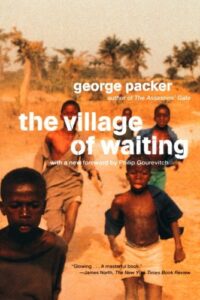
His book was published in 1984 and republished several times, most recently with a foreword by Philip Gourevitch. The book is not an enduring memoir because of the anecdotes, but the moral unease that shadows every page. Packer arrived in Togo in the early 1980’s, expecting to teach English—and, of course, to “make a difference” — but instead found a village vacillating between resignation and reliance.
Packer aptly begins his story quoting from Carlo Levi’s classic memoir of exile in a neglected place in southern Italy, where Christ stopped in Eboli, where the state, church, and progress abandoned the peasants.
Was even he perhaps another person, an unknown and still unmade young man whom change and time had thrust down there under those yellow animal eyes, those black eyes of women and men and children…so that he might find himself in otherness, in the other-than-self, so that he might discover history outside of history, and time outside of time, and the original pain of things, and himself, outside of the mirror of Narcissus’ pool, in men, on the arid earth?
He uses the tragedy of non-existent health care to demonstrate the limitations of his good intentions. Including haunting passages, villagers who were sick but unable or unwilling to tell doctors, driving physicians to despair when they encountered patients on their deathbed with gangrene. “Having done what I could, I’ve done nothing” was the depressing core of the memoir.
Packer is especially insightful on the racial dynamics in which some white expatriates appeared to bestow themselves a “divine right” inherited from colonial times. He uses Norfolkittel in Kenya, where whites congregated in their own cultural bubble, which insulated them from the people they claimed to serve.
He tells of the persistent suspicion among the local population, which many Peace Corps Volunteers like me experienced, regarding a perceived link between the Peace Corps and the CIA. Instead of sensationalizing this mistrust, he showed how the rumor reflected a deeper reality about American power abroad and how even well-meaning volunteers carry the weight of U.S. geopolitical presence.
One of the things that sets this memoir apart is that Packer wrote an “Afterword” seventeen years after publication, revealing that he left Togo and the Peace Corps due to what he described as a “nervous breakdown”. Evidently, enough time had passed to reveal why he left, and his story wasn’t complete until he acknowledged his own unraveling. He wouldn’t be the first PCV to suffer from a convergence of isolation, cultural dislocation, and the realization that he could not meet his own expectations for success.
Packer profiles three children and tries to help represent some of the different paths through the maze of poverty and a lack of opportunity. Even one child who managed to obtain a good education but ultimately cannot find a meaningful job. This depiction reflects The Economist’s description of Africa as “the hopeless continent,” a description he neither endorses nor rejects, but one that is reflected in his own lived experience.
The final line in his book, “My time in Africa now seems long ago, and yet the people I knew are still alive. They still wait.” Acknowledging that so many are still waiting for medical care, political change, and economic opportunities.
As a fellow Returned Peace Corps writer, I can’t help but speculate how Packer’s experience impacted his career as a consummate storyteller and investigative reporter for The Atlantic, where he’s written on Iraq, inequality, and American decline. His time in Africa might have activated a degree of moral seriousness, a skepticism toward power, empathy without sentimentality, and an ability to confront uncomfortable realities. All of which has served him well as a successful writer.
About the Author
George Packer is an award-winning author and staff writer at The Atlantic. His books include The Unwinding: An Inner History of the New America (winner of the National Book Award), The Assassins’ Gate: America in Iraq, and Our Man: Richard Holbrooke and the End of the American Century (winner of the Hitchens Prize and the Los Angeles Times Book Prize for biography). He is also the author of two novels and a play, and the editor of a two-volume edition of George Orwell’s essays. He’s a returned Peace Corps Volunteer from Togo (1982-83).
About the Reviewer
Mark D Walker was a Peace Corps Volunteer in Guatemala (1971-73) and spent over forty years helping disadvantaged people in the developing world. Walker’s three books are: Different Latitudes: My Life in the Peace Corps and Beyond; My Saddest Pleasures: 50 Years on the Road, named Best Travel Book of the Year, and he’s working on an expanded edition. The Guatemala Reader: Extraordinary Lives and Amazing Stories won the BookFest Award for Nonfiction Travel. He’s written 80 book reviews, and of his 30 published essays, two were recognized by the Solas Awards for Best Travel Writing. He’s a contributing writer for the “Arizona Authors Association Digest,” “The Wanderlust Journal,” “Literary Traveler,” and “The Great Writers You Should be Reading.” His wife and three children were born in Guatemala. You can learn more at www.MillionMileWalker.com