
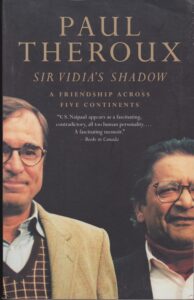
One of the joys of reviewing books is getting to know fellow writers, which is why I selected this book, as I admire both writers. Paul Theroux’s Sir Vidia’s Shadow is one of the most intimate, unsettling, and revealing portraits of a literary friendship. It is a study in mentorship, ambition, ego, and the corrosive effects of genius on human relationships. The book traces Theroux’s thirty‑one‑year relationship with V. S. Naipaul—beginning in a University in Kampala in the mid‑1960s, when Theroux was a young Peace Corps teacher, and Naipaul was already a rising star—and follows its evolution through admiration, dependence, rivalry, estrangement, and, finally, a surprising late‑life reconciliation.
The relationship begins in Uganda, where Theroux encounters Naipaul as a kind of literary rock star—brilliant, intimidating, and already the author of A House for Mr. Biswas, one of my favorite novels, which led some critics to call him “the greatest living English writer.” Naipaul, nicknamed Vidia, was knighted in 1990 and received the Nobel Prize for Literature in 2001. For the young Theroux, Naipaul was not simply a model but a living embodiment of what a writer could be: disciplined, uncompromising, and fiercely intelligent. Early on, Theroux becomes Naipaul’s apprentice, absorbing the master’s lessons—about prose, about travel, about the writer’s life.
The mentorship was real: Naipaul read Theroux’s drafts, offered guidance, and pushed him toward a higher standard. In these years, the friendship feels symbiotic: Naipaul gains a devoted younger companion; Theroux gains a literary father figure.
As the decades pass, the relationship becomes more complicated. Fame alters Naipaul, and success alters Theroux. What began as an apprenticeship becomes a rivalry, and what began as admiration becomes a mixture of affection, resentment, and bafflement. Although Theroux claims that he didn’t write out of vengeance, “I haven’t turned on Naipaul.” He says. “This is about the complexities of friendship.”
One of the most revealing threads is the way personal relationships intersect with literary ones. Theroux’s connection with Naipaul’s first wife, Pat, is tender and respectful; he portrays her as the emotional ballast in Naipaul’s life, a woman whose quiet suffering and loyalty stand in stark contrast to Naipaul’s increasing emotional austerity. But the dynamic shifts which Naipaul later marries Nadira, whose presence accelerates the distancing between the two writers.
Theroux’s transparency includes revealing his subconsciousness. He recounts recurring dreams—dreams of pursuit, judgment, and reconciliation—that underscore how deeply the older writer inhabited his psyche. These dreams are not literary devices; they reflect how thoroughly Naipaul became a symbolic figure in Theroux’s inner life.
Theroux is equally unflinching in his criticisms. He says of Naipaul, “Years of skepticism had given Vidia a fixed mask of suspicion—a sour mouth, a raptor’s beak, cheated eyes…You never wanted that face turned against yours.”
After years of silence—years in which Naipaul abruptly cut him off, and years in which Theroux believed the friendship irretrievably lost—the two men meet again unexpectedly at the Hay Festival. I didn’t understand the resolution of this rift until I found out about the epilogue Theroux wrote for the 2011 edition—13 years after the first.
Theroux’s tone in this final section is markedly different from the rest of the book. The anger has dissipated; the hurt has softened. What remains is perspective. The epilogue reframes the entire narrative—not as an indictment but as a testament to the complexity of human bonds, especially those forged in the crucible of artistic ambition. Evidently, Theroux found a diary from those later years, which, for him, is written to forget things, but in this case proved to him that he didn’t need it.
The book ends with a chance encounter at a large conference, where Theroux spots Naipaul and a writer friend urges him to approach Naipaul. Theroux touched his arm, and when Naipaul turned scowling, he said, “Hello Vidia,” and he said, “Paul Theroux.” With a beaming smile, he took Theroux’s hand and said, “How good of you to greet me like this.”
Theroux said, “I’ve missed you.” “Yes, yes, yes.” Theroux was moved as Naipaul squeezed his hand, smiled, and was led away.
In the end, the shadow in the title is not only Naipaul’s. It is the shadow cast by any formative relationship that shapes a life and a career. Theroux steps out of that shadow in the act of writing this book, and in doing so, he gives readers a compelling portrait of a literary friendship.
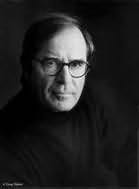
About the Author:
Paul Theroux was a Peace Corps volunteer in Malawi from 1963 65. His many books (56) include Picture Palace, which won the 1978 Whitbread Literary Award; The Mosquito Coast, which was the 1981 Yorkshire Post Novel of the Year and joint winner of the James Tait Black Memorial Prize, and was also made into a feature film. Burma Sahib was his latest novel.
About the Reviewer:
Mark D. Walker was a Peace Corps Volunteer in Guatemala (1971-1973). He spent over 40 years helping disadvantaged people in the developing world through agencies such as World Neighbors, Food for the Hungry, MAP International, and Make-A-Wish International, and as the CEO of Hagar USA. His memoir, Different Latitudes: My Life in the Peace Corps and Beyond, was recognized by the Arizona Authors Association. The first edition of his second book, My Saddest Pleasures: 50 Years on the Road, won the Peace Corps Writers’ Award for Best Travel Book. His third book, The Guatemala Reader: Extraordinary Lives and Amazing Stories, is a Bestseller, recipient of the BookFest Award for self-discovery, travel journals, and nominated for the Eric Hoffer Award. All three books are part of the Yin & Yang of Travel Series. His wife and three children were born in Guatemala.