
Dear Colleagues and Fellow Writers from Around the World,
After a quick update on the cover for my next book, My Saddest Pleasures, I’ll provide my take on the growing cost of war and what we can do about it in Culture Watch. What We’re Reading and Why will be a twofer— with a recent article How Scammers Impact Writers as well as the latest book I reviewed and then What Others Are Saying, plus an updated Calendar.

While we wait for the Library of Congress Number for Peace Corps Writers to begin publishing my book, here’s the first draft of the cover. Let me know what you think.
I took the picture on the cover on Lake Chalalán at the Chalalán Ecolodge in the heart of Madidi National Park in Bolivia’s Amazon basin, one of the most biodiverse protected areas on earth. When a group of us paddled to the far end of the lake, the jungle literally exploded with screeching Capuchin and Titi monkeys. The energy of Mother Nature had come alive before our eyes.
Culture Watch: The Cost of War Today
Here’s a sobering reminder of the cost of US wars from Vietnam: 58,200 soldiers and 2 million civilians killed, to Iran, which cost $11.3 billion in the first six days and to day 45 billion while the Pentagon is still asking for another $1.5 Trillion more—that’s trillion with a “T”.
According to an analysis by the Cost of War Project at Brown University’s Watson Institute of International and Public Affairs, US-led wars since 2001 have directly caused the deaths of about 940,000 people across Afghanistan, Pakistan, Iraq, Syria, Yemen and other post-9/11 conflict zones and as the war with Iran lingers and Israel continues to pummel Lebanon and kill reporters and medical personnel in Gaza those number will only increase. Since February 28, US-Israeli attacks on Iran have killed at least 3,375 people, according to Iran’s Ministry of Health. The US military has confirmed 13 combat-related deaths among its service members across the region, with more than 200 injuries.
The cost can be measured in many ways. The Pentagon plans to spend $2.2 Trillion on post-war care for veterans, which probably isn’t enough. Add to that the cost at the pump and increased prices for a growing number of things all Americans pay due to tariffs and new “expeditions” (wars).
According to a Reuters/Ipsos poll from April 12, 60 percent of Americans disapprove of US military strikes on Iran. This is up from a 43 percent disapproval rating at the start of the war. President Trump’s disapproval rate of 60% has reached Dwight D. Eisenhower’s rate for the Vietnam War.
The growing number of overseas wars was one of the motivators for the last No Kings protest on March 28th. Most of our children and grandchildren were among the 8 million in 3,300 locations who were there. The latest protest, May 1st, saw immigration rights morph into broader worker/farmer rights with a growing number of war protest signs as the Iran War has exceeded the Vietnam War in public unpopularity. Follow this link for more details and some revealing graphics: The cost of 76 years of US wars, from Korea to Iran | US-Israel war on Iran News | Al Jazeera

What We’re Reading and Why: A Twofer
Online Scams Targeting Authors
Authors have been inundated with online scams lately. Scammers excel in psychology, and since every author loves readers, they play on the desire for more readers and the delight readers feel when they say, “I loved your book!” (Hint: If your money is involved, they’ve never read it.) Read the article to learn more.
The article was written by Katy Cook the President of the Arizona Authors Association and yours truly, a board member of AAA as well as an Advisory Board member of Peace Corps Writers. It was initially published in the April/May 2026 edition of the Arizona Authors Digest. To learn the origin of these scams and more useful resources follow the link below and scroll down to page 17,and for an added bonus—my latest Million Mile Walker Review of a memoir by travel writer, Tom Miller on page 45. AAD Apr | May 2026 Share your own favorite scam encounter in comments below and tell us when you realized it wasn’t legit and what you did. I’ll share some of the best stories down the line.
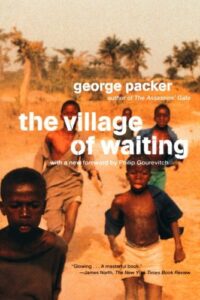
I first came across Packer from his cover story “The Valley,”—the second-longest that The Atlantic published in the past 40 years, in which he provides a kaleidoscopic view of the precarious political and physical ecology of Phoenix regarding climate change, which meant a lot to me in the summer of 2024 as we were suffering record-breaking, triple-digit temperatures. I found out that he’s a staff writer for the “Atlantic” magazine but had no idea he was a Returned Peace Corps Volunteer until a fellow PCV (Peace Corps Volunteer) serving in Togo gave me a heads-up.
When I started reading his memoir, I realized it was a perfect fit for the Million Mile Walker Review. This was not another feel-good Peace Corps memoir. He refused easy answers, showing how serving in an isolated, unknown culture can break you while finding meaning in the challenges. His honesty models the reflective courage that epitomizes the best travel literature.
His book was published in 1984 and republished several times, most recently with a foreword by Philip Gourevitch. The book is not an enduring memoir because of the anecdotes, but the moral unease that shadows every page. Packer arrived in Togo in the early 1980’s, expecting to teach English—and, of course, to “make a difference” — but instead found a village vacillating between resignation and reliance.
The final line in his book also resonated with me, “My time in Africa now seems long ago, and yet the people I knew are still alive. They still wait.” Acknowledging that so many are still waiting for medical care, political change, and economic opportunities.
As a fellow Returned Peace Corps writer, I can’t help but speculate how Packer’s experience impacted his career as a consummate storyteller and investigative reporter for The Atlantic, where he’s written on Iraq, inequality, and American decline. His time in Africa might have cultivated a degree of moral seriousness, skepticism toward power, empathy without sentimentality, and the ability to confront uncomfortable realities. All of which has served him well as a successful writer. Follow this link for the full review: https://millionmilewalker.com/2026/04/the-village-of-waiting-by-george-packer-reviewed-by-mark-d-walker/
For those interested in the impact of book reviews. Click here to see my entire Zoom workshop for the Arizona Authors Association on the Power of Book Reviews last month: The Million Mile Walker: A Literary Journey with Mark D. Walker.
What Others Are Saying and Why
Hi, Mark. I thought you did a good job with the review of Mark Wentling’s new book. Congratulations. MJ 4/9 Mark Jacobs (Stone Cowboy) on my review of Mark Wentling’s latest book
I can’t thank you enough for the nice review shown below. You have really gone much farther than expected. I’m impressed by the amount of work and time you put into drafting this review. Mark Wentling on my review of his book, Born n Kansas But Made in Africa.
Congratulations on taking the decluttering steps that I talk about and don’t get far, principally because the memories of the items overtake my need to declutter. Your success has pushed me to start again. Steve Kaffen, fellow travel writer, My Twin Cities: Rio and Buenos Aires on my downsizing initiative.
Calendar

The APW (Arizona Professional Writers) Conference on April 24th received a superior rating. Speakers included Nancy Hicks Marshall (third from the right), former Director of ACLU Arizona and author of Dry Hate, which I reviewed. I was recruited to judge an impromptu creative writing contest and saw many fellow writers from several literary associations. The Western Spirit Museum in Old Town Scottsdale was an ideal venue, and I highly recommend the tour they offered. Exhibitions – Western Spirit: Scottsdale’s Museum of the West
You can find my 85 book reviews and 28 articles, as well as several videos and photos, on my website, which also offers a reduced price for my new book if you read it and pass it along to your local library: http://millionmilewalker.com “Follow” me on Blue Sky—at (2) @millionmilewalker.bsky.social — Bluesky, Substack- Mark D Walker| Substack– and Facebook https://www.facebook.com/millionmilewalker/ for the latest international affairs and literature. And please share the sign-up page link with the Dispatch for any friends you think would enjoy it. Million Mile Walker Newsletter – Million Mile Walker.
And, as always, if you’ve read Different Latitudes: My Life in the Peace Corps and Beyond, My Saddest Pleasures: 50 Years on the Road, the Best Travel Book according to the Peace Corps Writers, and, of course, my most recent book, The Guatemala Reader, please review and rate them on Amazon and Goodreads.
Shalom!
Mark D. Walker