
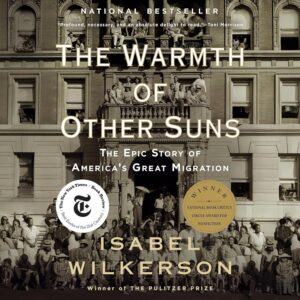
I became aware of Wilkerson’s work by reading Caste and purchased the audio version of this book, which took 23 hours, but it was worth the effort. Wilkerson’s The Warmth of Other Suns is one of the more ambitious works of narrative history I’ve ever read, with a sweeping, intimate chronicle of the Great Migration told through the lives of three ordinary yet emblematic African Americans who left the Jim Crow South in search of dignity, safety, and opportunity.
Published in 2010, the book reframes migration not as a demographic shift but as an act of self-liberation. I wanted to finish reading it in June as a continuation of the story that Juneteenth commemorates: the long, unfinished journey from bondage toward full citizenship.
Wilkerson’s narrative structure tells the stories of three protagonists, starting with Ida Mae Brandon Gladen, a sharecropper from Mississippi. Here’s a story of quiet resilience, not a political actor. Then we meet George Starling, the working-class citrus picker, who, like so many, left after World War II, disillusioned with American Democracy and his work organizing fellow pickers. And the professional striver, Dr. Robert Foster, a physician from Louisiana who embodies the aspirations of educated migrants who sought both safety and professional recognition and represents the black middle class.
Wilkerson uses transportation not merely as a matter of logistics but as a metaphor. Ida Mai’s train ride to the North evokes the biblical exodus. George Startt’s train escape’s clandestine nature reflects the dangers of staying in the South. And Dr. Foster’s cross-country drive dramatizes the humiliation of Jim Crow, the use of the Green Book, and the constant challenge of finding safe places to stay the night.
Wilkerson does not romanticize the North, but she is clear about the stakes for those who remained in the South. They faced continued disenfranchisement, economic exploitation, racial terror, and legalized segregation.
Wilkerson’s research is itself a monumental act of historical recovery. She spent 14 years conducting interviews, over 1,200 conversations with migrants, and many hours in archives, census records, and oral history. She blends journalism, ethnography, and narrative nonfiction. Her hybrid approach captures both the emotional and historical reality of migration.
Wilkerson’s later book, Caste, makes explicit what The Warmth of Other Suns implies: the Jim Crow South operated as a rigid caste system, with African Americans assigned a fixed, hereditary position. The Great Migration was, in effect, a mass act of civil disobedience—six million people refusing to live within the constraints of that hierarchy.
The migrants were not simply seeking jobs; they were seeking confirmation of their own self-worth. And they rejected a system which told them where to live, what they could earn, and where they could move. In this sense, the Great Migration is one of the largest acts of nonviolent resistance in American history.
Wilkerson’s epilogue dismantles several enduring myths, such as the North being a racial utopia while experiencing redlining and job discrimination. Secondly, migrants brought crime and disorder, when in reality, crime rates rose due to overcrowding, discriminatory housing policies, and, lastly, that migration was purely economic, which was really about freedom, safety, and dignity. Her final insight is that the Great Migration reshaped American culture—music, literature, politics, sports, and civil rights activism all bear its imprint.
I wanted to finish this book in time for the Juneteenth celebration, which marked the day the last enslaved people in Texas learned of their freedom — two and a half years after the Emancipation Proclamation. But freedom on paper did not translate into equality. The century that followed saw the rise of Jim Crow, racial terror, and economic exploitation.
The Warmth of Other Suns shows what happened after Juneteenth—how African Americans continued the struggle for liberation by voting with their feet. The Great Migration was the second emancipation, a grassroots movement that forced the nation to confront its contradictions.
The book deepens the holiday meaning of Juneteenth by connecting emancipation to the long fight for civil rights; honoring the courage of those who left; reminding us that freedom is not a moment but a process; and exposing the structural barriers that persist long after slavery’s end to this very day.
Reading Wilkerson’s book during Juneteenth deepens the holiday’s meaning: Juneteenth is about liberation delayed; while The Warmth of Other Suns is about liberation pursued.

About the Author
Isabel Wilkerson is the winner of the Pulitzer Prize and the National Humanities Medal. Her debut work, “The Warmth of Other Suns,” won the National Book Critics Circle Award for Nonfiction and was named “Time’s 10 Best Nonfiction Books of the 2010s. She taught at Princeton, Emory, and Boston universities and has lectured at more than 200 other universities in the U.S., Europe, and Asia.
About the Reviewer
Mark D Walker was a Peace Corps Volunteer in Guatemala and spent over forty years helping disadvantaged people in the developing world. Walker’s three books are: Different Latitudes: My Life in the Peace Corps and Beyond; My Saddest Pleasures: 50 Years on the Road, named Best Travel Book of the Year; and The Guatemala Reader: Extraordinary Lives and Amazing Stories. He’s written 80 book reviews, and two of his 30 published essays were recognized by the Solas Awards for Best Travel Writing. His wife and three children were born in Guatemala. You can learn more at www.MillionMileWalker.com