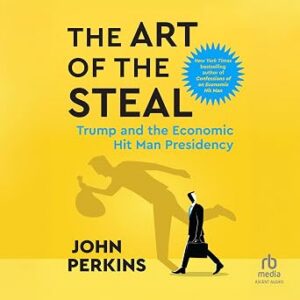
John Perkins is best known as the “Economic Hitman”. I was enthralled by his revelations in this first book, which I read thirty years after my own overseas development career. I was impressed by his firsthand account of working as an economist whose job was to lure developing countries into debt arrangements that benefited large corporations and our own country’s geopolitical interests. His books on global economics, corporate power, and Indigenous wisdom have sold millions of copies in more than 35 countries and spent over 70 weeks on the New York Times bestseller list.
Perkins applies this theory domestically with a provocative claim: President Trump is not an anomaly in American history but a milestone. He contends that Trump represents the culmination of decades of growing corporate power, economic inequality, media manipulation, and wealth concentration. What makes Trump unique is that he combines two functions that historically have been separate, such as the “Economic Hitman” by adding “jackals” with threats, intimidation, and attacks on institutions.
He focuses on four pillars that sustain the growing corporate empire such as debt, based on his experience of countries losing leverage and policy decisions increasingly meeting the needs of creditors, not citizens. Military occupation was no longer necessary when financial obligations can accomplish many of the same things. He applies this concept to individuals through student loans, credit-card debt, medical debt, and housing debt, creating populations that are economically constrained and politically cautious.
Changing perceptions was another key pillar, using the example of Ecuador, where oil corporations polluted Indigenous lands and dumped waste, which helped create an environmental catastrophe, and government forces were used to crush resistance. This was made possible when Indigenous peoples were portrayed as obstacles to progress rather than the defenders of their homelands and local culture. He contends that if citizens believe environmental protections destroy jobs, immigrants threaten their livelihoods, or foreign populations are inherently dangerous, policies that benefit powerful corporate interests become easier to implement.
Perkins shows how fear impacts modern political movements by cultivating anxiety and hate rather than confidence. Claims that the US is “collapsing” are a way to frighten the public to make it more willing to surrender freedoms, accept inequality, and trust a strongman figure who promises protection.
Fear also supports another pillar: “divide-and-conquer” strategies that keep the citizenry from uniting around common economic interests. While divisions of race, nationality, religion, or ideology ensure that people focus on fighting rather than examining who benefits from a given conflict.
Perkins’ encounter with the Dalai Lama was inspirational and transformational. He was invited to the Dalai Lama’s home in India expecting to discuss Buddhism. Surprisingly, the Dalai Lama gave him impactful advice. Don’t become a Buddhist. The world needs more compassion, not religions- something Perkins experienced with the Shuar community. The visit deepened his belief that compassion should be the foundation for social, economic, and environmental change, a theme that runs through his subsequent advocacy work.
The author’s Peace Corps experience shaped him at both the beginning and the end of his time abroad. While living with the Shuar people in the Amazon rainforest, he learned a foreign language and began to question the system he’d eventually serve. This lesson would eventually motivate him to leave his lucrative position as an Economic Hitman. Consequently, he devoted himself to promoting a different model of development. He helped form the Pachamama Alliance to advance Indigenous rights, environmental projects, and collaborative approaches, in contrast to his former top-down, corporate models.
At the end of the book, Perkins lays out a call to action that bridges the gap between grassroots Peace Corps experience and the need to promote global economic systems. He offers these basic steps:
- Become aware of the power structures.
- Change personal behavior by aligning spending, investing, and lifestyle choices and influencing political, media, and consumer culture.
- Change personal behavior
- Hold corporations accountable.
- Build movements and tell new stories.
- Build movements and tell new stories that inspire collective action.
Whether you agree with all of Perkins’ conclusions or not, The Art of the Steal forces us to confront an uncomfortable question: who benefits from the stories we are told, and who pays the price when we believe them.
“Ultimately, Confessions is a parable for all Americans who try to deny the heartbreaking fact that our society’s affluence often comes at the wider world’s expense.”
—Utne Reader
About the Author
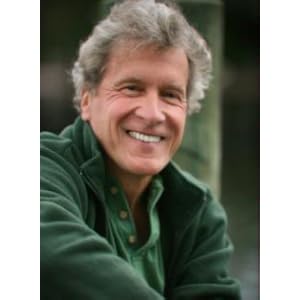
John Perkins is the author of 12 books on global intrigue, economics, shamanism, and transformation, including “Confessions of an Economic Hit Man,” and “Touching the Jaguar.” They have been on the New York Times bestseller list for more than 70 weeks, sold millions of copies, and are published in at least 38 languages. His latest, “Message from Pleiades,” is the story of a life-and-world-changing experience in an ancient Mayan city; it is his first novel (written under the pen name of J P Moody).
As chief economist at a major consulting firm, John advised the World Bank, UN, Fortune 500 corporations, US and other governments. He regularly speaks at universities and economic and environmental forums and is a founder of the Pachamama Alliance and Dream Change, nonprofit organizations that partner with indigenous people to protect environments and offer programs to change the destructive ways of industrial societies.