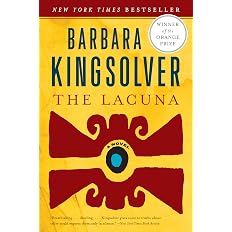
The Poisonwood Bible by Barbara Kingsolver is one of my favorite books, and Demon Copperhead, where the author used Charles Dickens’“David Copperfield” as a model to introduce us to life in the Appalachians, is amazing, so when I learned she had a book that took place in Mexico, I was sold. The author is an honorary member of the Arizona Authors Association, and as a board member, that was a bonus.
I found that The Lacuna is a historical novel that blends political upheaval, artistic innovation, and personal identity into a richly layered narrative. It’s set in Mexico and Asheville, North Carolina, during the 1930s and ’40s and later during the McCarthy era. Harrison Shepherd is the main character, a diarist, cook, archivist, and eventually bestselling novelist who intersects with some of the most influential figures of the twentieth century.
The author’s research into Mexican history, art, and daily life is extensive, grounding the novel in authentic detail, which I appreciated since I’ve worked and traveled there many times. Harrison’s early years include work in the household of Diego Rivera and Frida Kahlo, where he learns to mix plaster for Rivera’s murals—an exacting process of layering lime, sand, and pigment onto wet surfaces. Kingsolver’s descriptions of mural preparation reveal not only technical precision but also the political stakes of Rivera’s art, which championed workers, indigenous identity, and socialist ideals.
The novel also highlights Mexican cultural traditions, such as the rosca de reyes, the ring‑shaped pastry baked for Epiphany. Kingsolver uses the rosca—complete with its hidden Baby Jesus figurine—as a symbol of community, celebration, and the unexpected revelations that shape Harrison’s life. My wife, who is from Guatemala, follows this tradition with her students who love searching for the baby Jesus.
Mexican artist and political activist Frida Kahlo emerges as the novel’s most compelling figure. Kingsolver portrays her not as a mythic icon but as a woman of fierce intelligence, humor, and vulnerability. The book acknowledges her lifelong physical suffering—stemming from a catastrophic bus accident that led to dozens of surgeries—and her emotional wounds, including miscarriages and turbulent relationships. Kingsolver’s Frida is both fragile and formidable, a mentor to Harrison and a living embodiment of the fusion between art and pain. Her presence deepens the novel’s exploration of how creativity can arise from trauma.
Leon Trotsky’s arrival in the Rivera-Kahlo household introduces global political conflict into Harrison’s personal world. Kingsolver’s depiction of Trotsky is grounded in historical fact: the exiled revolutionary lived under constant threat from Stalin’s agents, who ultimately assassinated him. The novel provides “a concise and interesting summary of Trotsky’s dispossession by Stalin,” highlighting the brutality of Stalin’s regime and the ideological battles that defined the era.
Trotsky’s presence also foreshadows the political persecution Harrison will face in the United States. During the McCarthy era, his Mexican associations and perceived political sympathies make him a target of suspicion, forcing him to flee the country. Kingsolver uses Harrison’s ordeal to examine how fear and nationalism can distort justice.
Throughout the novel, Kingsolver profiles characters from diverse social backgrounds—artists, cooks, soldiers, and bureaucrats to reveal how class and power shape human experience. One of the most striking historical episodes is the massacre of unpaid US troops after the First World War. Kingsolver uses this to illustrate governmental neglect and the human cost of political decisions. By weaving such events into Harrison’s narrative, she underscores the recurring patterns of exploitation and injustice that transcend national borders.
Harrison’s evolution from a shy, observant boy to a celebrated novelist is one of the book’s most rewarding arcs and one my fellow writers will appreciate. Mentored by writers and archivists, he develops a keen sense of how stories are constructed—and how they can be manipulated. At the height of his career, he receives up to an impressive 100 fan letters per day, a testament to his popularity but also a burden that isolates him further. His manuscripts, often hidden or fragmented, reflect the novel’s central theme: the difficulty of preserving truth in a world eager to distort it.
Kingsolver uses Harrison’s career to comment on the craft of writing itself. His work is shaped by discipline, curiosity, and the willingness to confront uncomfortable truths—qualities that Kingsolver clearly values in her own practice.
I listened to the audiobook version of this book and enjoyed Kingsolver’s use of language. She incorporates Spanish phrases, regional Mexican dialects, and period‑specific American English to create an authentic linguistic landscape. The audible version enhances this richness, with narrators shifting seamlessly between accents and languages, giving voice to characters across social classes and cultural backgrounds. This multilingual texture reinforces the novel’s themes of identity, belonging, and cultural hybridity.
The story and origin of the book’s title are fascinating and revealing on several levels. Lacuna carries two intertwined meanings, one textual and one mythical. The first is the familiar definition: a gap, an omission, a missing piece in the historical record or in memory. Kingsolver uses this meaning to expose how public narratives distort private truth, how political hysteria erases nuance, and how Harrison Shepherd’s life is repeatedly misrepresented by the documents meant to preserve it. His diaries contain literal gaps, and his public reputation is shaped by the voids between what happened and what the world chooses to remember. This “lacuna” is the breach between truth and presumption, a political wound created by propaganda and fear.
But in the novel’s final pages, Kingsolver reveals the second, mystical meaning in Mexico: an ocean cave, a hidden passage beneath the surface. This metaphor aligns with Mesoamerican myth, where caves and underwater tunnels often serve as portals between worlds—spaces of transformation, rebirth, and escape from oppressive forces.
After political persecution in the United States becomes unbearable, Harrison returns to Mexico with his loyal secretary, Violet Brown. Their trip is meant to be restorative return to the landscapes and cultural rhythms that shaped his youth. Instead, it becomes the site of the novel’s final and most devastating lacuna.
While swimming in the sea, Harrison disappears. His body is never recovered. Violet Brown, who has devoted her life to preserving his manuscripts and protecting his legacy, is left with only fragments—diaries, letters, and memories. The ocean becomes the ultimate metaphor: vast, unknown, swallowing truth whole.
Kingsolver leaves readers with an unresolved absence. Harrison’s disappearance is not only a personal tragedy; it is a commentary on how political hysteria, cultural displacement, and the fragility of identity can erase a life. The final lacuna is the gap between what happened and what can never be known.
Although published in 2009, The Lacuna speaks to contemporary concerns such as media misinformation and political polarization—the ideological battles between the Trotskyists, Stalinists, and McCarthyites reflect many current divisions. Harrison’s struggles as a “permanent foreigner,” born in the US but brought up in Mexico, reflect debates about nationality and belonging. Also, Rivera’s murals and Frida’s painting remind us how art can be a form of political expression, and Harrison’s disappearance underscores how easily truth can vanish and how urgently it must be protected.
Kingsolver’s novel ultimately argues that the gaps—the lacunae—in our collective memory shape our understanding of history and ourselves. By illuminating these voids, The Lacuna encourages readers to question dominant narratives and seek deeper truths.