
Friends and Colleagues from Around the World,
Which books help us celebrate our 250th anniversary as the fireworks go off, so we can see beyond the spectacle to the shadows behind it, which are rarely spoken or acknowledged? I’ve chosen four books that reveal some of the things we’re not taught at school or that we ignore, and yet they offer insights into often-overlooked phenomena that have made our country what it is.
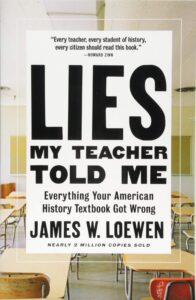
“Lies My Teacher Told Me: Everything Your American History Textbook Got Wrong,” by James Loewen, is as good a place to begin thinking about the United States at 250. Loewen’s core claim—that much of American history is either sanitized, distorted, or erased in the stories we teach children—lands differently when you read it on the eve of a semi-quincentennial. A country preparing to celebrate itself ought to ask what, exactly, it has chosen to remember. Loewen’s book, which has sold well over a million copies and become a staple in classrooms and reading groups, reminds us that the “official” narrative is only one version of the past, and often the least honest one. By excavating buried episodes of genocide, labor struggle, imperial expansion, and resistance, he gives readers a set of corrective lenses.
Loewen’s importance to a 250th‑anniversary conversation is twofold. First, he shows how mythmaking works: how textbooks turn conquest into “settlement,” slavery into a regrettable footnote, and dissent into a quirky sidebar. Second, he insists that ordinary citizens can unlearn these myths. The book’s longevity and strong sales are themselves a quiet referendum on the hunger for a truer story. If millions of people have bought a book whose premise is that their education misled them, then the United States at 250 is not just a nation of consumers—it is, at least potentially, a nation of revisionists, willing to reopen the case on its own past. Here’s my review of the book with an author profile: Lies My Teacher Told Me: Everything Your American History Textbook Got Wrong, by James W. Loewen. Reviewed by Mark D. Walker – Million Mile Walker.

If Loewen exposes the lies, Isabel Wilkerson’s The Warmth of Other Suns gives those lies a human scale. Her epic account of the Great Migration—roughly six million Black Americans leaving the Jim Crow South for cities in the North and West—turns what is often treated as a demographic trend line into a series of intimate, life‑altering journeys. The book has sold hundreds of thousands of copies and become a modern classic of narrative history, precisely because it refuses to treat Black movement as an abstraction. Instead, Wilkerson follows three individuals over decades, showing how the decision to leave Mississippi, Florida, or Louisiana reverberates through their work, love, family, and identity.
For a 250th‑anniversary reflection, this book matters because it reframes the map of the United States. The Great Migration literally remade the country we are celebrating in 2026: its music, politics, neighborhoods, and conflicts all bear the imprint of those journeys. Yet this transformation rarely appears in the patriotic highlight reel. Wilkerson’s book insists that the United States is not just a story of founding fathers and frontier expansion, but of people fleeing racial terror and trying to make a livable home inside a nation that has never fully wanted them. To understand the “United” States, we have to understand who had to move, and why. The Warmth of Other Suns by Isabel Wilkerson, Reviewed by Mark D. Walker – Million Mile Walker

If Wilkerson and Loewen focus on the internal ordering of American life, Daniel Immerwahr’s How to Hide an Empire widens the lens to the globe. His book is basically about two maps—one that we’ve been taught in school and another that has been ignored and rarely discussed. The term “empire” applies to other countries but rarely to the United States. Most Americans see their country as a republic born from revolution and, therefore, hostile to imperial rule, but that’s not the case, and therein lies the story.
The map we’re familiar with is of the contiguous fifty states, which doesn’t match the country’s legal borders. This “logo map” ignores Hawaii, Alaska, and Puerto Rico, which have been part of the country since 1899. And what about the actual territories, the atolls, islands, and archipelagos this country has governed and, in many cases, inhabited? For more than two centuries, the U.S. has been a kind of empire made up of territories barely acknowledged in popular conceptions of the country. How To Hide An Empire: A History Of The Greater United States by David Immerwahr, Reviewed by Mark D. Walker – Million Mile Walker

One of the indelible images Immerwahr leaves us with is atolls and islands which make up a network of eight hundred overseas military bases worldwide, as compared to Russia, which had nine leads to our next book by David Vine, who maps the vast network of U.S. military bases and interventions, arguing that war is not an occasional emergency but a near‑permanent condition of the American state. The book has reached a substantial readership in academic and activist circles, selling tens of thousands of copies and becoming a key text in debates over foreign policy and militarism. Its title alone is a provocation: what does it mean to celebrate the “United States” when so much of its energy has been devoted to projecting force far beyond its borders?
For a 250th‑anniversary dispatch, Vine’s work is crucial because it connects domestic myths to overseas realities. At 250, the United States is not just a republic with a colorful past; it is an empire with a global footprint. “The United States of War” asks us to include that footprint in our reckoning, to see the anniversary not only from Philadelphia or Phoenix, but from Okinawa, Guantánamo, and the many places where American power is felt but American citizenship is not. The relevance and accuracy of his book are illustrative of the recent military action of a surgical strike in Venezuela, to a three-month war with Iran costing over $100 billion. The United States Of War by David Vine, Reviewed by Mark D. Walker – Million Mile Walker

Everyone Who Is Gone Is Here brings the story back to the border, tracing how policy decisions, economic pressures, and violence across the Americas have produced what we now call an immigration “crisis.” As a newer book, its sales are still climbing. Still, it has already found a wide audience among readers trying to understand why the headlines about asylum, detention, and deportation never seem to stop. Blitzer’s reporting follows migrants, officials, and advocates through the labyrinth of laws and loopholes, showing how choices made in Washington ripple through villages in Honduras, shelters in Mexico, and neighborhoods in the United States.
Over 250 years, this book underscores a simple truth: the United States has always been shaped by movement across its borders and by the rules it writes to manage that movement. From the Chinese Exclusion Act to the Bracero Program to today’s asylum restrictions, immigration policy is a mirror held up to national self‑image. Who do we imagine belongs in this story? Who do we keep out, and at what cost? Blitzer’s book refuses easy answers, but it makes one thing clear: the “crisis” is not an accident. It is the predictable outcome of decades of decisions, many of them made in the name of security or sovereignty, all of them now converging on the lives of people who are simply trying to survive. The United States Of War by David Vine, Reviewed by Mark D. Walker – Million Mile Walker

Literature doesn’t change anniversaries; the parades will still march; the speeches and pontificating will still lean on familiar phrases. But books like these change readers, and readers change the questions they ask. As the United States turns 250, the most meaningful celebration may not be a perfectly choreographed commemoration. Still, a willingness to sit with the uncomfortable truths these authors lay out: that much of our history has been hidden, that our hierarchies are older and more entrenched than we like to admit, that our wars and our borders shape lives far beyond our line of sight.
For those interested in more insightful books on the world around us, here are my personal favorites—read on!
A Personal Note
I’ve submitted the final draft of the cover for My Saddest Pleasures to the editorial board at Peace Corps Writers and will soon submit the final proof of the manuscript to begin the publishing process.
We’re unpacking boxes as part of our “downsizing” project, which took us from Scottsdale to the Coronado Historic District in midtown Phoenix. Next to our son, his wife, and three Walker/Walker grandkids.
You can find my 85 book reviews and 28 articles, as well as several videos and photos, on my website, which also offers a reduced price for my new book if you read it and pass it along to your local library:
“Follow” me on Blue Sky—at (2) @millionmilewalker.bsky.social — Bluesky, Substack- Mark D Walker| Substack– and Facebook https://www.facebook.com/millionmilewalker/ for the latest international affairs and literature. And please share the sign-up page link with the Dispatch for any friends who might enjoy it. Million Mile Walker Newsletter – Million Mile Walker.
And, as always, if you’ve read Different Latitudes: My Life in the Peace Corps and Beyond, My Saddest Pleasures: 50 Years on the Road, the Best Travel Book according to the Peace Corps Writers, and, of course, my most recent book, The Guatemala Reader, please review and rate them on Amazon and Goodreads.
Shalom!
Mark D. Walker